
Abacus Classes for Kids: Age-by-Age Guide (Preschool to Age 12)
If you search for the best age for abacus classes, you'll find the same answer everywhere: 5–12 years. The range isn't wrong, but it isn't helpful either. A 5-year-old and a 12-year-old walking into their first abacus class have almost nothing in common — different attention spans, different existing number sense, different reasons for being there.
This is an age-specific guide. Find your child's stage — preschool, early primary, or upper primary — and get an accurate picture of what to expect, rather than one generic recommendation designed for a 6-year-old.
Why Abacus Teaching Should Look Different at Different Ages
The abacus is not merely a calculator — it is an Abstract Mental Arithmetic (Anzan) training tool that gradually transitions a child from concrete physical counting to abstract mental arithmetic. The teaching method must evolve with the child's cognitive development, which changes significantly between ages 4 and 12.
Three key elements change as a child grows:
Attention Span & Motor Skills
- Younger children need shorter game-style sessions and larger beads
- Older children sustain 45–60 minute structured speed drills
Abstract Reasoning
- Younger children rely on physical bead manipulation for months before mental visualization
- Older children grasp abstract numeric logic faster and begin mental image training sooner
School Maths Alignment
- A 6-year-old is learning basic addition concepts
- A 10-year-old works with multi-digit multiplication, division, and fractions
- Abacus should support — not replace — school learning
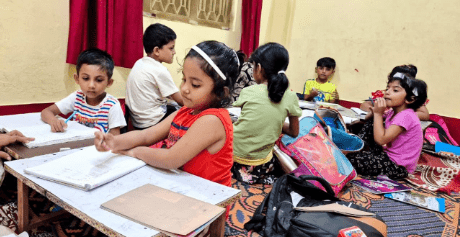
Preschool — Nursery to UKG (Ages 3–6)
Building the Foundation
Starting abacus training in preschool capitalizes on a unique window of rapid brain development and neuroplasticity. At this stage, the goal is to establish a solid mental foundation — not lightning-quick calculation.
Key Readiness Signs
Ages 3–5 are tactile learning years. Before enrolling, check that your child:
- Can recognize numbers 1–10
- Can use a pencil or play with small objects without frustration
- Can focus on a guided play task for at least 15–20 minutes
What Instruction Looks Like
Preschool abacus modules use colour-coded soroban boards, rhyming stories for bead rules (such as "Five Friends" or "Ten Friends"), and play-based finger exercises. Physical bead movement and strong quantity association come first — speed comes later.
Early Primary — Classes 1 to 3 (Ages 6–9)
The Most Common — and Ideal — Starting Point
If children didn't begin at preschool, this is the softest landing. Many children start in Class 1 or 2 and experience no disadvantage at all. This is the most typical entry point in practice.
Curriculum Arc at This Stage
- First few months: Bead values, simple addition and subtraction, finger dexterity on the abacus
- Next stage: Multiplication and division on the physical abacus; first steps toward visualization — thinking about bead positions without looking
- Later stages: More time on mental calculation; the physical abacus gradually becomes a check rather than a crutch
This period aligns well with what's happening in school. A simultaneous abacus class reinforces arithmetic concepts — place value, carrying, and borrowing — being formally introduced in Classes 1 through 3, from a complementary visual perspective.
Find the Right AVAS Abacus Program for Your Child's Age
Structured, age-segmented programs with certified trainers — from beginner abacus to advanced Vedic Maths.
Explore ProgramsUpper Primary — Classes 4 to 7 (Ages 9–12)
Fast-Track Focus and Competitive Readiness
Upper primary students bring very different cognitive strengths to abacus training compared to lower primary. Whether continuing from an earlier age or starting fresh, the experience is clearly more structured.
Continuing Students (Ages 9–12)
Children who began at age 6 or 7 are in the advanced range by age 10 or 11. They practice multi-digit multiplication, long division, decimals, and rapid-listening division drills.
Older Beginners (Ages 10–12)
Older beginners learn the physical bead rules approximately twice as fast as a 6-year-old — because of their logical understanding. However, translating that knowledge into fluid mental visualization (Anzan) requires more conscious daily effort, as their thinking patterns are more dependent on traditional step-by-step methods.
School Performance and Competitions
As students progress from Class 4 to Class 7, the academic load grows. Speed and accuracy become crucial for:
- School Exams: Avoiding basic arithmetic mistakes in multi-stage word problems
- Scholarship & Competitive Exams: Mental processing within strict time limits
- Math Olympiads: Speed, concentration, and numerical confidence
Abacus for a 12-year-old enhances concentration, working memory, and mental processing speed at a time when academic expectations are steadily increasing.
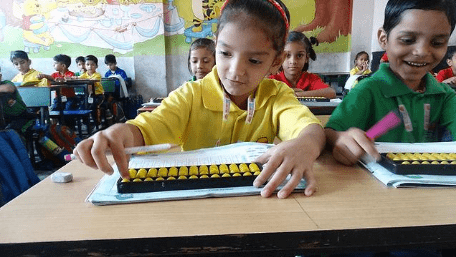
Is It Too Late to Start at Age 12?
No — but the objective changes. Parents often ask whether abacus is "useless" at age 10 or 11. This misconception comes from a lack of understanding of brain neuroplasticity. Maximum visual-spatial brain mapping takes place during ages 4–10, but an older child starting at 11 or 12 still benefits in tangible ways:
- Instant Numerical Confidence: Older children with low number confidence quickly build it through structured abacus practice
- Developing Concentration: Listening carefully and manipulating beads in a disciplined way builds focused attention
- Speed Processing: Even partial mastery of the mental abacus produces faster mental maths than the pencil-and-paper method
Realistic Changes for Older Beginners (Ages 10–12)
- Shorter Runway: Fewer years before high school coursework (algebra, geometry, trigonometry) requires a shift away from abacus
- Shift to Applied Maths: Once basics are mastered (typically in 12–18 months), many 11 or 12 year olds seamlessly move into Vedic Mathematics for high-school level algebra, squares, roots, and complex equations
What Changes at Each Age — At a Glance
| Stage | Age | Learning Pace | Focus | Ideal Batch |
|---|---|---|---|---|
| Preschool | 3–6 yrs | Slow / Gentle | Number recognition, motor skills, sensory play, bead movement | Micro-groups (3–4 students) or 1-on-1 |
| Early Primary | 6–9 yrs | Steady / Foundational | Formula mastery, place value, Anzan (mental visualization) | Small age-specific groups (5–8 students) |
| Upper Primary | 9–12 yrs | Fast-track | Quick rule mastery, speed Anzan, competitive practice | Performance-driven or competitive groups |
Selecting the Right Class for Your Child's Age
Not every abacus center does effective age banding. One clear red flag during institute evaluation is seeing a 5-year-old placed in the same instructional batch as an 11-year-old — using the same workbooks and progressing at the same pace.
What to Look For in an Age-Appropriate Program
- Age-segmented batches — Beginners should be grouped with others at the same academic level, not just the same curriculum
- Specialized trainers — Teaching a 5-year-old and a 10-year-old are fundamentally different skills; look for trainers with specific experience at your child's stage
- Flexible progression — Older children should not be held back on a fixed-months-per-level chart designed for younger learners
For a complete evaluation and comparison checklist, see our master guide: Best Abacus Classes for Kids in India (2026) — How to Choose the Right Institute
Frequently Asked Questions
What's the best age to start abacus classes?
Most children are at their optimal starting point between ages 5 and 8. At this stage, fine motor skills and number recognition are developed enough, while brain plasticity for visual-spatial Anzan (mental abacus) training remains high.
Can a 10 or 11-year-old still learn abacus effectively?
Yes. A 10 or 11-year-old learns abacus formulas much faster than a younger child due to their logical understanding. The lightning-fast mental visualization may require more conscious effort, but there are clear improvements in calculation speed, accuracy, and concentration.
Is the teaching approach different based on my child's age?
Absolutely. Preschool programs use play, short activity bursts, and colour-coded boards. Primary programs focus on formula fluency and mental visualization. Upper primary programs target exam-speed calculations and competitive mental processing.
Should my child start with abacus or skip straight to Vedic Maths?
For a child whose main goal is to improve basic calculation speed and mental concentration, 1–2 years of abacus first is the better path. But if an 11 or 12-year-old is already comfortable with basic arithmetic and wants help with complex concepts — square roots, algebra, multi-digit multiplication — Vedic Maths may be the better fit.
How long does the full abacus curriculum take?
A typical abacus program has 8–10 levels. If a child starts at age 6 or 7, trains weekly, and practices a few minutes daily at home, the full curriculum usually takes 2–3 years. Older beginners often complete the basic levels in a shorter timeframe.
Find the Right AVAS Abacus Program for Your Child
Age-segmented batches, certified trainers, and a government-recognized curriculum — across 300+ cities in India and live online. Book a free trial class today.
Book a Free Trial Class